Type approval: what it means that a tuner is a manufacturer
When a company like Alpina or Brabus takes on type approval, it stops being an accessory supplier and becomes legally responsible for the whole car.

The dossier, not the dyno sheet. Approval is a documentation exercise before it is an engineering one.
The threshold that changes everything
Most tuning work sits below a regulatory line that most customers never see. Fit a set of coilovers, remap an ECU, bolt on a body kit — none of that, in isolation, triggers the obligation to re-certify the vehicle as a new type. The car retains the identity its manufacturer gave it, and responsibility for the base vehicle stays with the original maker. Cross the line, and the calculus inverts entirely.
That line is drawn by whole-vehicle type approval: the process by which a vehicle is certified as meeting construction and use regulations, emissions standards, and passive and active safety requirements as a complete, integrated system. In Europe the current framework is EU Regulation 2018/858 ↗, which replaced the older directive-based system and brought with it market surveillance obligations and far tighter control over what approval authorities can accept as evidence. The test programme covers everything from pedestrian impact geometry to brake fade under repeated high-speed stops, from noise at a measured pass-by to emissions across a cold-start drive cycle. A tuner that issues its own type approval is certifying all of it.
What triggers the obligation? Broadly, any modification that could affect the performance envelope the original approval was granted for. Change the engine fundamentally, raise the power output beyond what the approval authority judges the driveline and braking system were certified to handle, alter the structure, or modify the passive safety geometry — and you are in territory where a new or amended approval is the only legal route to production. The subtlety is that "fundamentally" is contested ground. Manufacturers, tuners, and approval authorities negotiate precisely where that word sits, and the negotiation is expensive.
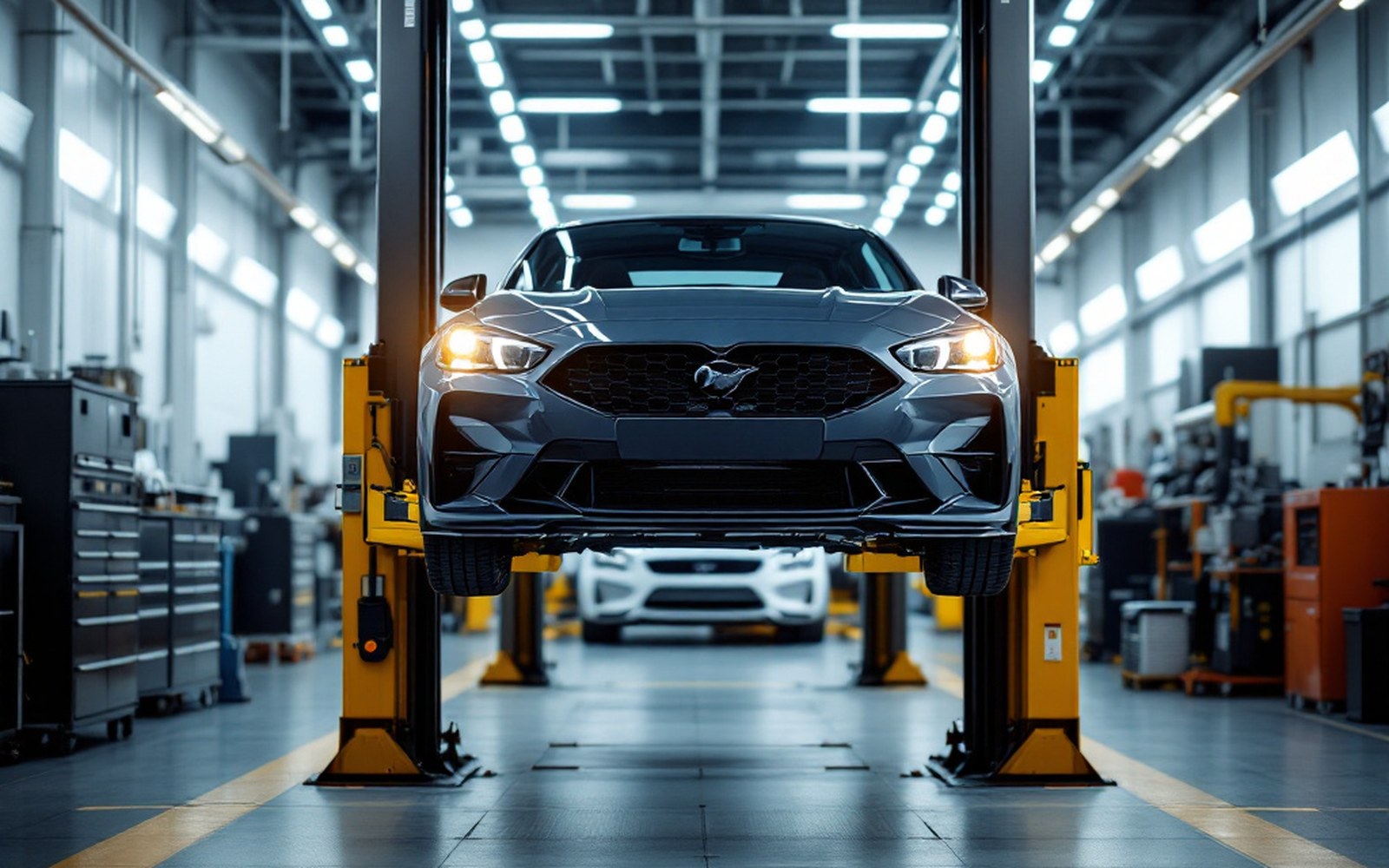
The underside is where the certification questions actually live. Most owners never see it.
What it actually costs — and who absorbs it
The cost of type approval is one of the least-discussed reasons the aftermarket looks the way it does. Running a full programme — crash testing at an accredited facility, emissions testing across multiple drive cycles, noise, electromagnetic compatibility, lighting geometry, tyre-load ratings — runs into millions of euros before a single vehicle is sold. That expenditure is only recoverable at scale, which is why the companies that hold their own approval tend to operate at volumes that look absurdly small by OEM standards but are, for a specialist manufacturer, the minimum the economics permit.
Alpina, based in Buchloe, Bavaria, has been officially recognised as a vehicle manufacturer since 1983 and builds cars under its own VIN prefix, making it legally a vehicle manufacturer rather than a tuner in German and EU law. The approval responsibility that comes with that status means Alpina must validate not just its engine and transmission modifications but the suspension geometry, braking system, and structural integrity of the complete vehicle — including the changes its engineers make to roll centres, spring rates, and wheel load distribution. AC Schnitzer ↗ and Brabus, by contrast, operate under a different framework for most of their range: they certify individual components or packages as modifications to an approved base vehicle, which keeps their obligation narrower but also limits how far they can deviate from what BMW or Mercedes-Benz already certified.
The approval hierarchy — who carries what
- Whole-vehicle type approval holder — certifies the complete vehicle, issues its own VIN, carries liability for the system
- Component/modification approval — certifies a specific change to a base-approved vehicle; liability stays narrower, deviation from base is limited
- No formal approval — modification is owner's responsibility; base manufacturer's certification may no longer apply
Nismo — Nissan Motorsports International — sits in a different position again. As a subsidiary of a volume manufacturer, it can leverage the parent company's testing infrastructure and approval relationships, which substantially reduces the cost of certifying a performance variant. That structural advantage partly explains why a factory motorsport division can offer a complete vehicle to a specification that an independent tuner could not reach without prohibitive approval spend.
For a small independent operator, this cost structure is essentially a ceiling. You can remap, you can modify suspension within the envelope of the base approval, you can change wheels within the certified load and geometry parameters — but you cannot, in practice, hold your own whole-vehicle type approval without either the capital of a specialist manufacturer or the backing of an OEM. A plate is the difference between a car and a modified car, and issuing that plate means owning every number on it.
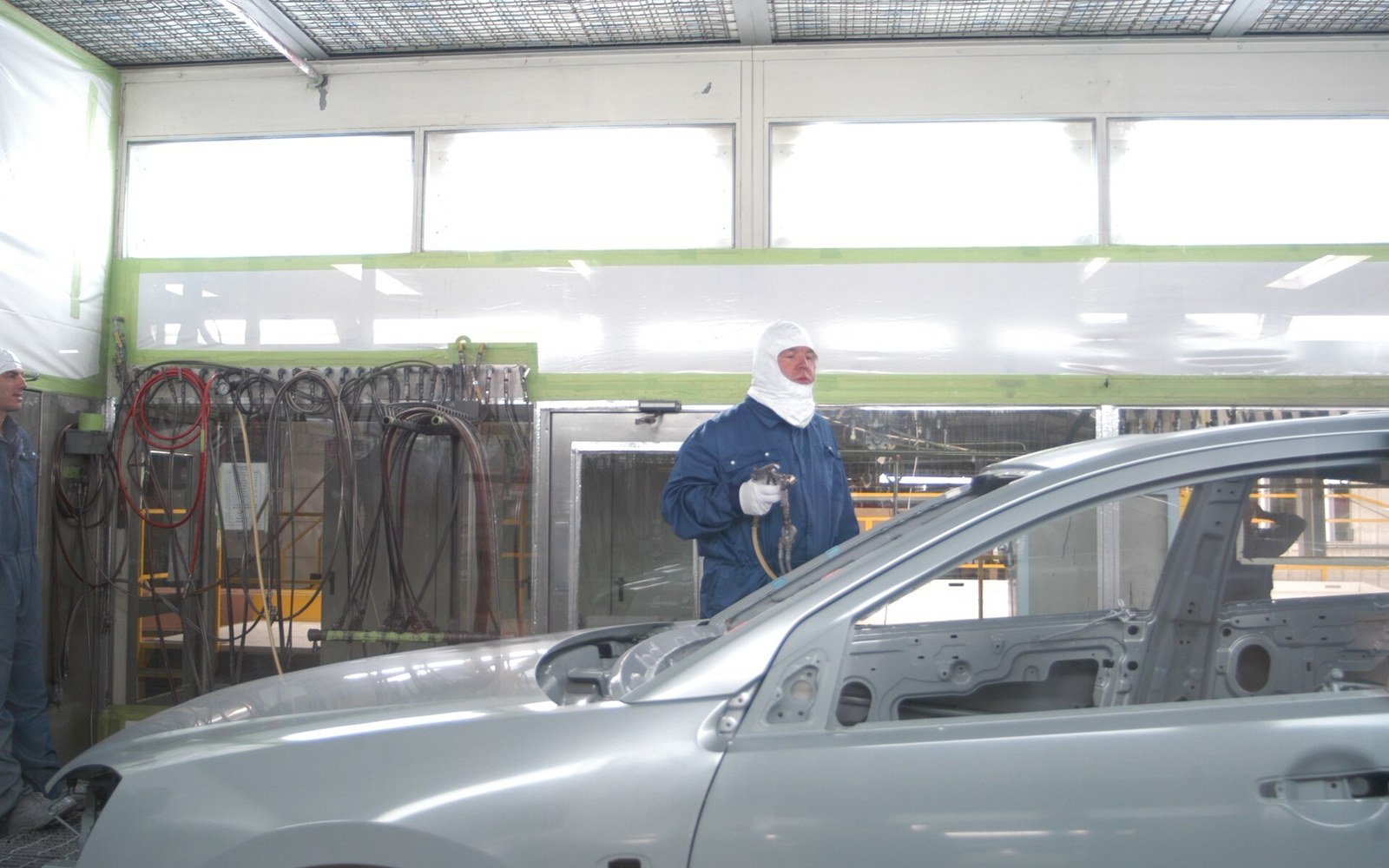
Preparation is the job. The gun is the last afternoon of it.
Photo: Spray booth · Wikimedia Commons
What approval actually demands from the engineering
Understanding why approval is expensive requires understanding what it tests, because the tests are designed around the idea that a vehicle is a system, not a collection of components. Change the power output materially, and the brakes must be re-evaluated: the kinetic energy they absorb under emergency braking scales with mass and the square of velocity, so a significant power increase is implicitly a brake capacity question even if the discs and calipers are unchanged. Change the suspension geometry — lower the car, alter the unsprung mass by fitting forged wheels of a different offset, adjust spring rates — and the tyre load envelope at the certification limit must be re-examined. Change the engine and its emissions equipment, and you re-enter the drive cycle.
Charge cooling efficiency matters here in a way that goes beyond power output. An intercooler or water-methanol system that raises the achievable knock margin in laboratory conditions must be shown to perform consistently across ambient temperature ranges, altitude variations, and the ageing of components — because the approval is for a production vehicle that will be used across a decade, not a development prototype tuned for a single dyno session. Approval authorities are well aware that forced-induction systems can be optimised for a test cycle in ways that do not reflect real-world use, and the surveillance obligations in the current EU framework explicitly address this.
Key regulatory anchors
- EU Regulation 2018/858 — the current whole-vehicle type approval framework for Europe, replacing the earlier directive structure
- Real-driving emissions (RDE) testing — on-road measurement with a Portable Emissions Measurement System, part of Euro 6d and later; approval must cover real-world output, not just a laboratory cycle
- Conformity of production — the obligation that each production unit meets the same standard as the certified prototype; an ongoing audit obligation, not a single test
The structural side is no simpler. Wide-body kits that alter the vehicle's frontal area affect the pedestrian impact assessment; suspension modifications that change ride height alter the bumper strike zone relative to the pedestrian impact geometry the vehicle was originally assessed for. An approval holder is certifying a relationship between all of these parameters simultaneously, not a list of individual parts. That is why aero that works at a competition level rarely reaches road-car approval unchanged: the compromise between downforce, drag, and pedestrian safety geometry is genuinely difficult to resolve within the approval framework without purpose-designed structure.
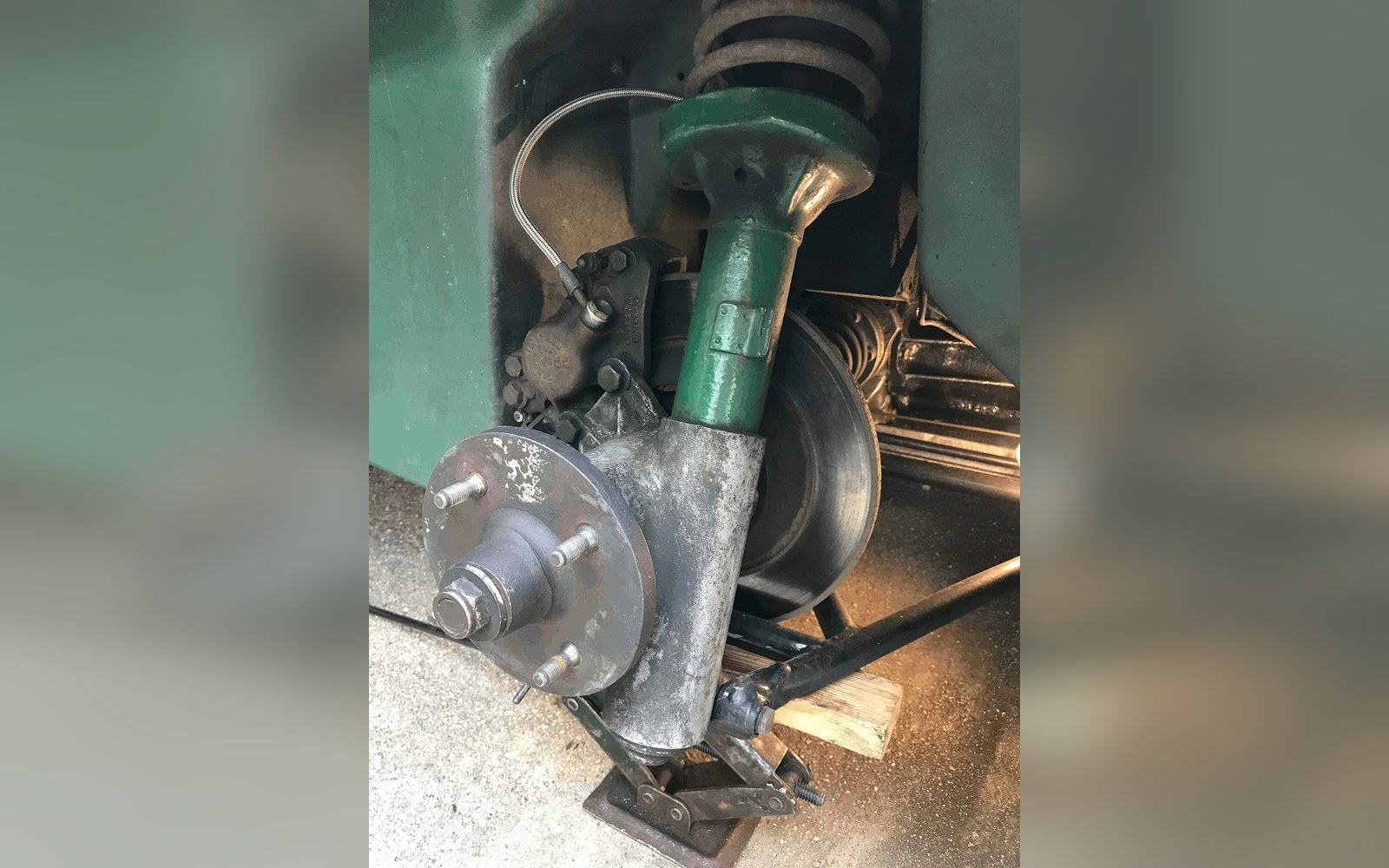
One corner with the wheel off. Every change here is paid for in compliance.
Photo: Lotus Elan Rear Suspension Hub · Wikimedia Commons
The emissions dimension has become progressively stricter. Euro 6d and its successors include real-driving emissions testing — on-road measurement with a Portable Emissions Measurement System rather than purely a laboratory cycle — and the window between a manufacturer's certified emissions and the real-world output of a modified vehicle has narrowed considerably. A tuner holding whole-vehicle approval must certify the modified vehicle's emissions, not the base vehicle's, and must demonstrate conformity of production: the hundredth car built must meet the same standard as the first.
This is the engineering trade-off that the cost figures do not fully capture. Approval is not a one-time expense; it is an ongoing obligation. Conformity of production audits, market surveillance, recall obligations if a safety defect is identified — these are the liabilities that come with the plate. The companies that carry them do so because the alternative is to remain, commercially and legally, an accessory supplier. For a few operators, that ceiling is worth buying through. For most of the industry, it defines the outer edge of what the work is.
Read next in A plate is the difference